COURSE TITLE
Introduction to Water Reed Thatching using traditional and modern tools and techniques
COURSE OVERVIEW / DESCRIPTION
Introduction to Water Reed Thatching using traditional and modern tools and techniques is a beginner course on covering a pitched roof with water reed (Phragmites australis) as practised in Ireland. Water reed is a marsh stem. Laid butt-end outward in overlapping courses on a steep pitch, it sheds rain from the surface rather than soaking through the coat. The course covers how reed differs from straw, how bundles are judged, how a roof is prepared, how courses are fixed from eaves to ridge, and how ridges, maintenance, fire safety, and heritage rules are handled.
Three Irish sites sit behind this overview:
– Thatching Ireland (https://ThatchingIreland.com) is a specialist water-reed thatching practice working across Ireland with traditional and contemporary methods, and sourcing its own water reed. Use it as a picture of professional reed work on houses, cottages, garden structures, and heritage buildings.
– Thatching Tools Ireland (https://ThatchingTools.ie) supplies thatching tools and materials, including mallets and water-reed bundles. Use it when the lessons on the leggett, scollops, sways, and modern screw-and-wire fixings need a real kit list.
– Boglands thatching workshops (https://Thatch.Boglands.ie) offers roof-thatching workshops at Boglands Hideaway. Use it as the hands-on next step after this introduction. This course does not replace time on a roof with a working thatcher.
The course has 11 lessons. Each lesson is followed by a short quiz. It is an introduction only. It does not replace an apprenticeship, a structural check, insurance, or consent where a building is protected.
MasterStudy setup: paste this overview into the course description. Add each lesson as a text lesson, then add its quiz immediately after that lesson. Use Single Choice and True/False question types. Suggested passing grade: 70–80%.
================================================
SECTION 1: FOUNDATIONS
================================================
LESSON 1: What Is Water Reed Thatching?
Water reed thatching is the craft of covering a pitched roof with bundles of reed so that rain runs off the surface instead of soaking through. Reed stems are hollow and coated with a waxy, silica-rich skin. When thousands of butts are aligned and packed, water travels only a short distance into the coat — often about 25–50 mm — and then runs down the slope.
A sound water-reed roof needs:
– A steep pitch, commonly 45 degrees or steeper, so water sheds quickly.
– Bundles laid butt-end outward, in overlapping courses from eaves to ridge.
– Fixings buried well below the weathering face.
– A finished thickness suited to the length of the reed, often in the region of 250–350 mm (about 10–14 inches), not an overly thick coat that lies too flat.
– A flexible ridge capping, frequently straw rather than reed, renewed more often than the main coat.
In Ireland, a properly laid water-reed roof is widely described as lasting about 20–40 years, depending on reed quality, pitch, exposure, workmanship, and maintenance. The ridge usually needs attention sooner, often every 10–15 years. Lifespan figures vary by source and site; coastal exposure and overhanging trees shorten life.
Thatch is a breathable, renewable roof finish. It is also a skilled trade. Poor pitch, damp reed, weak fixings, or a flat-lying coat can fail early.
For worked examples of water-reed roofs, see https://ThatchingIreland.com. For hands-on follow-up, see https://Thatch.Boglands.ie.
QUIZ: What Is Water Reed Thatching?
Question 1 (Single choice)
Which statement best describes how water reed sheds rain?
- A) The stems are solid and absorb nothing
- B) Aligned, packed stems form a surface that water runs off
- C) A plastic membrane is always required under the reed
- D) The ridge is made of metal in every case
Correct answer: B
Question 2 (Single choice)
A commonly recommended minimum roof pitch for water reed is about:
- A) 15 degrees
- B) 25 degrees
- C) 45 degrees
- D) 80 degrees
Correct answer: C
Question 3 (True/False)
Moisture typically soaks through the full thickness of a well-laid reed coat.
Correct answer: False
Question 4 (Single choice)
In Irish conditions, a water-reed coat is often expected to last roughly:
- A) 2–3 years
- B) 20–40 years, depending on quality and exposure
- C) 100 years with no maintenance
- D) Only one winter
Correct answer: B
Question 5 (Single choice)
Which part of a thatched roof usually needs renewal sooner than the main coat?
- A) The ridge
- B) The rafters only
- C) The ground under the building
- D) The window glass
Correct answer: A
————————————————
LESSON 2: Water Reed Thatching in Ireland
Ireland’s older thatch tradition used whatever long, local material was available: wheat, rye, oat, and sometimes flax straw, plus marram grass, heather, rushes, and sedge. Sedge was valued in wet lowlands, especially for ridging. Water reed was part of that regional picture, not the only material.
Munster has a noted tradition of indigenous water reed. In the north, historical use was more limited, including areas around Lough Neagh and possibly the River Foyle. Native Irish reed is often described as coarser in appearance than some imported reed. The Shannon and its tributaries once supplied large quantities. Nutrient runoff can make reed grow longer and faster, but softer and less durable, so old beds are not automatically good thatching beds.
Imported water reed has been used in Ireland since about the 1950s. Norfolk-style reed techniques have spread because reed lasts longer than most straw and needs less frequent recoating. Traditional Irish fixing of reed was often similar to straw work: courses secured with hazel or willow scollops. Modern new work commonly uses battens, screws, and steel sways.
Roped and pegged thatch belong mainly to exposed coastal straw traditions. Guidance from Irish built-heritage sources notes that, of the historic methods, scolloped thatching is the one used for reed. Regional variety has narrowed as speed, cost, and longer-lasting imported reed have favoured a smaller set of methods.
See current water-reed practice at https://ThatchingIreland.com.
QUIZ: Water Reed Thatching in Ireland
Question 1 (Single choice)
Which region is particularly associated with a tradition of indigenous water reed?
- A) Munster
- B) Only inland deserts
- C) Nowhere in Ireland
- D) Only city centres
Correct answer: A
Question 2 (Single choice)
Imported water reed became established in Ireland from about the:
- A) 12th century only
- B) 1950s
- C) 2020s
- D) 9th century
Correct answer: B
Question 3 (True/False)
Fertiliser runoff can make reed longer but poorer in quality for thatching.
Correct answer: True
Question 4 (Single choice)
Historic Irish thatch materials included:
- A) Only plastic tiles
- B) Straw, and in some districts reed, marram, heather, rushes, or sedge
- C) Only slate
- D) Concrete only
Correct answer: B
Question 5 (Single choice)
The historic fixing method associated with reed in Irish guidance is:
- A) Scolloped thatching
- B) Pouring loose gravel
- C) Nailing slate only
- D) Leaving bundles untied
Correct answer: A
================================================
SECTION 2: MATERIAL AND TOOLS
================================================
LESSON 3: The Plant, Harvest, and Bundle Quality
Water reed is a perennial wetland grass. Rhizomes send up shoots in spring. By late summer the stems are tall and green. Harvest waits until after frost has stripped the leaves and growth has returned to the roots, commonly between January and March. Cutting too early leaves leaf and sap that can rot in the roof.
Usable stems are often about 900–2000 mm long (roughly 3–6½ feet); good thatching reed is frequently described as about 5–7 feet. Stems are cleaned of leaf and broken material and tied into bundles. A working figure used in Irish repair guidance is about 11 bundles per square metre of roof, though yield depends on bundle size and coat thickness.
Judge reed before it goes on the roof:
– Straight, firm stems with a clean butt.
– Consistent length within a bundle.
– Low leaf, weed, and moisture content. Reed must be dry.
– Not overly soft, pithy, or blackened from poor storage.
– A tight butt when the bundle is knocked down on a board.
Wet reed moulds, slips under the sway, and fails early. Store bundles off the ground, covered but ventilated, and use them in the season they are bought if possible.
Water-reed bundles and related supplies are listed at https://ThatchingTools.ie.
QUIZ: The Plant, Harvest, and Bundle Quality
Question 1 (Single choice)
Water reed is best harvested:
- A) In midsummer while fully green and leafy
- B) After frost, typically winter to early spring, once leaves have dropped
- C) Only in August rain
- D) As seed heads alone
Correct answer: B
Question 2 (Single choice)
The botanical name commonly used for water reed is:
- A) Phragmites australis
- B) Quercus robur
- C) Triticum aestivum only
- D) Calluna vulgaris
Correct answer: A
Question 3 (True/False)
Damp reed is acceptable if it is tied tightly.
Correct answer: False
Question 4 (Single choice)
A figure cited for reed quantity is about:
- A) 11 bundles per square metre
- B) 1 stem per roof
- C) 200 bundles per square metre in every case
- D) Half a bundle for a whole house
Correct answer: A
Question 5 (Single choice)
A quality bundle should show:
- A) Firm, straight stems and a clean, even butt
- B) Mostly leaf and weed
- C) Black mould throughout
- D) Mixed lengths with no butts aligned
Correct answer: A
————————————————
LESSON 4: Water Reed Compared with Straw
Irish roofs may be long straw, combed wheat reed, or water reed. They are not the same material or the same finish.
– Long straw is threshed cereal straw, often with a softer, slightly poured look. It is traditional across much of Ireland. Life is commonly shorter than reed, and it needs more regular attention. It can be easier to patch.
– Combed wheat reed is cereal straw combed so stems lie parallel, giving a neater face. Eaves are often cut to a line. From a distance it can resemble water reed.
– Water reed is a marsh stem, denser and more water-resistant. Butts are usually left uncut on the face, so the eaves show the natural ends. It is harder to patch in small spots and is often recoated or repaired in sections. New reed work may require stripping back to the structure rather than simply stuffing a thin overlay.
Ridge work is a special case. Water reed is stiff. Wheat or other straw is often preferred for the ridge because it bends and binds. Sedge has also been a traditional Irish ridging material in wet districts.
Choose material with the building in mind. A protected vernacular house may be expected to keep its historic straw tradition. A new build may specify water reed for longevity. Do not assume imported reed suits every historic roof.
QUIZ: Water Reed Compared with Straw
Question 1 (Single choice)
Compared with long straw, water reed is generally:
- A) Less durable
- B) Denser and longer lasting
- C) Impossible to fix
- D) Always cut to a sharp eaves line like wheat reed
Correct answer: B
Question 2 (Single choice)
Why is straw often used on a water-reed ridge?
- A) Straw is stiffer than reed
- B) Straw is more flexible and bonds well over the apex
- C) Reed cannot get wet
- D) Straw never needs replacement
Correct answer: B
Question 3 (True/False)
Combed wheat reed and water reed are identical plants.
Correct answer: False
Question 4 (Single choice)
A practical limitation of water reed is that:
- A) It cannot shed water
- B) Small patches are harder than on softer straw
- C) It must be laid flat
- D) It has no bundles
Correct answer: B
Question 5 (Single choice)
On a historic Irish house, material choice should consider:
- A) Only the cheapest import
- B) Regional tradition and any conservation requirements
- C) Removing all pitch
- D) Painting the reed black
Correct answer: B
————————————————
LESSON 5: Traditional and Modern Tools
Traditional kit is simple and still in daily use:
– Leggett (leggat): a flat, handled board, often with a patterned face, used to dress and tighten the butt ends.
– Mallet or beetle: drives scollops.
– Scollops (scallops): hairpin-shaped hazel or willow pegs that pin a horizontal rod into the coat.
– Sways, stretchers, or liggers: long straight rods, traditionally hazel, laid across the courses.
– Needles and tarred cord or twine: for sewing courses to the roof or to older thatch.
– Shears, knife, and eaves hook: trimming and finishing.
– Ladders, crawl boards, and roof brackets: access. Never rely on the thatch itself as a foothold.
Modern fixing adds:
– Battery drill and long bits or drivers.
– Stainless or other specified screws into battens.
– Steel rod sways and stainless tying wire, often twisted with a wire twister.
– Screwfix rails or similar proprietary systems on some new roofs.
Metal in the coat should be specified for durability and kept well covered by reed so it does not become the weathering face. Traditional timber pegs remain appropriate on many repairs and on roofs where a like-for-like fixing is required.
Tool and material examples: https://ThatchingTools.ie. How those tools are used on finished roofs: https://ThatchingIreland.com. Practice workshops: https://Thatch.Boglands.ie.
QUIZ: Traditional and Modern Tools
Question 1 (Single choice)
A leggett is used to:
- A) Cut glass
- B) Dress and tighten the butt ends of the reed
- C) Mix cement only
- D) Harvest fish
Correct answer: B
Question 2 (Single choice)
A scollop is:
- A) A twisted hazel or willow peg
- B) A type of slate
- C) The metal chimney only
- D) A plastic ridge tile
Correct answer: A
Question 3 (True/False)
Modern water-reed roofs may be fixed with screws, steel sways, and wire as well as with traditional pegs.
Correct answer: True
Question 4 (Single choice)
Fixings should be:
- A) Left proud of the surface
- B) Buried under a good cover of reed
- C) Omitted on the eaves
- D) Made of untreated string only on a new public roof
Correct answer: B
Question 5 (Single choice)
Safe access depends on:
- A) Standing only on loose reed
- B) Ladders, boards, and proper roof access equipment
- C) Jumping between barges
- D) Removing all battens first
Correct answer: B
================================================
SECTION 3: BUILDING THE ROOF
================================================
LESSON 6: Roof Structure and Preparation
Reed is a heavy, deep covering. The roof structure must be designed or checked for the load, including wet reed and wind uplift. Rafter spacing, batten size, and fixing specification are structural decisions; on a real project they belong with a competent designer and, where required, building control.
Typical preparation for new reed work:
– Pitch at least about 45 degrees, steeper in harsh exposure.
– Battens or laths at centres suited to the fixing method.
– A clear ventilation path so the underside of the coat is not trapped against impermeable insulation. Thatch needs to dry toward the roof space as well as outward.
– Eaves detail that allows a tilt or kick, often a timber fillet or a roll of reed near the wall, so the first course springs outward and drips clear of the wall.
– Fire separation, chimney details, and escape provisions as required for the building type. Public and some new buildings may need additional fire treatment or construction.
On an old roof, do not bury sound decisions under a thick overlay. Irish repair guidance favours understanding the existing coat, fixing type, and structure before adding reed. Strip back where the base is rotten, compressed flat, or insecure. Record what you find on a protected building.
QUIZ: Roof Structure and Preparation
Question 1 (Single choice)
The eaves kick is there to:
- A) Let water run back into the wall
- B) Spring the first course so water drips clear of the wall
- C) Flatten the reed
- D) Replace the ridge
Correct answer: B
Question 2 (True/False)
Thatch can be sealed tight against impermeable insulation with no thought for drying.
Correct answer: False
Question 3 (Single choice)
Before overlaying an old roof you should:
- A) Ignore rotten undercoat
- B) Check structure, fixing, and condition of the existing coat
- C) Remove all pitch
- D) Soak the reed
Correct answer: B
Question 4 (Single choice)
Reed load and wind uplift are:
- A) Irrelevant
- B) Structural matters for a competent design check
- C) Solved by paint
- D) Only a problem on sheds under 1 metre
Correct answer: B
Question 5 (Single choice)
A fillet or reed roll at the eaves is used to:
- A) Create the tilt of the first course
- B) Block the chimney
- C) Hold guttering only
- D) Replace sways
Correct answer: A
————————————————
LESSON 7: Laying the Coat from Eaves to Ridge
Work starts at the eaves and moves up. Bundles are opened, the butts knocked level, and the reed placed so the cut or butt ends form the weathering face. Each course overlaps the one below. The fixing line sits well up the stem, leaving a deep cover of reed over the sway. Irish guidance suggests a minimum cover around 100 mm and preferably about 150 mm, because reed may wear on the order of 6 mm a year.
Thickness follows reed length. Short reed (about 1.5 m or less) may suit a coat around 250 mm. Longer reed may be laid nearer 350 mm. A coat of 400 mm or more can force stems to lie too flat, which shortens life. The aim is a tight, even face, not the greatest possible depth.
The leggett is used to drive the butts up into a solid plane and correct high or low spots. Courses are kept to a consistent gauge. Valleys, dormers, and brows need extra care so water cannot track sideways into the coat. The gable or barge is turned or layered so wind cannot lift the edge.
Do not force a pattern that fights the reed. Water reed wants a straight, quill-like face. Dress often, stand back often, and correct while the course is still open.
Finished water-reed coats can be compared with work shown at https://ThatchingIreland.com.
QUIZ: Laying the Coat from Eaves to Ridge
Question 1 (Single choice)
Courses are laid:
- A) From ridge down only, with no overlap
- B) From eaves upward, overlapping
- C) Only on the chimney
- D) In a single vertical bundle
Correct answer: B
Question 2 (Single choice)
An overly thick coat can be a problem because:
- A) Reed then lies too flat and can wear faster
- B) Water cannot fall
- C) Fixings become unnecessary
- D) The leggett will not mark it
Correct answer: A
Question 3 (True/False)
The leggett is used to dress the butt face into an even plane.
Correct answer: True
Question 4 (Single choice)
Fixings need a substantial cover of reed because:
- A) The surface slowly wears back toward the sway
- B) Wire must be visible
- C) Rain should hit the screws
- D) Cover is only decorative
Correct answer: A
Question 5 (Single choice)
The weathering face of water reed is formed by:
- A) The butt ends
- B) Loose seed heads only
- C) Tar paper
- D) The rafter ends
Correct answer: A
————————————————
LESSON 8: Fixing Methods — Scollops, Sways, and Screw Ties
Two families of fixing are in use.
Traditional scollop fixing. A horizontal sway lies across the course. Hazel or willow scollops are driven through or over that rod and back into the coat or into the course below, pinning the reed. Eaves may take extra tension: tarred cord, twine, or a double row of sways. This method suits repairs and roofs being kept in a traditional system. Pegs must be sound, green enough to twist without snapping, and long enough to grip.
Modern screw-and-rod fixing. On new work, screws are driven into battens, wire is attached, bundles are set, a steel sway is laid, and the wire is tied and twisted so the sway clamps the reed. The steel and wire end up buried several inches under the finished face. Both approaches are effective when correctly done. The choice depends on the roof, the specification, and whether like-for-like repair is required.
Whichever method is used:
– Fix every course before it can slip.
– Keep fixings at a consistent height so wear does not expose them early.
– Do not rely on friction alone.
– On a steep pitch, reed’s weight needs secure fixing, especially at eaves and barges.
Related tools and fixings: https://ThatchingTools.ie.
QUIZ: Fixing Methods
Question 1 (Single choice)
A sway is:
- A) A horizontal rod clamping the course
- B) A type of window
- C) The chimney pot
- D) Wet leaf waste
Correct answer: A
Question 2 (Single choice)
On many new roofs, reed is clamped by:
- A) Steel sways tied with wire to screws in the battens
- B) Gravity only
- C) Paint
- D) Loose stones on the apex
Correct answer: A
Question 3 (True/False)
Eaves courses often need stronger tension than the general face.
Correct answer: True
Question 4 (Single choice)
Like-for-like repair on a traditional roof may call for:
- A) Hazel or willow scollops
- B) Removing the pitch
- C) Asphalt only
- D) No fixings
Correct answer: A
Question 5 (Single choice)
Fixings fail early if they are:
- A) Too close to the weathering face
- B) Well covered and consistently placed
- C) Tied at eaves and barges
- D) Checked before the next course
Correct answer: A
================================================
SECTION 4: FINISHING AND CARE
================================================
LESSON 9: Ridges, Barges, and Weather Details
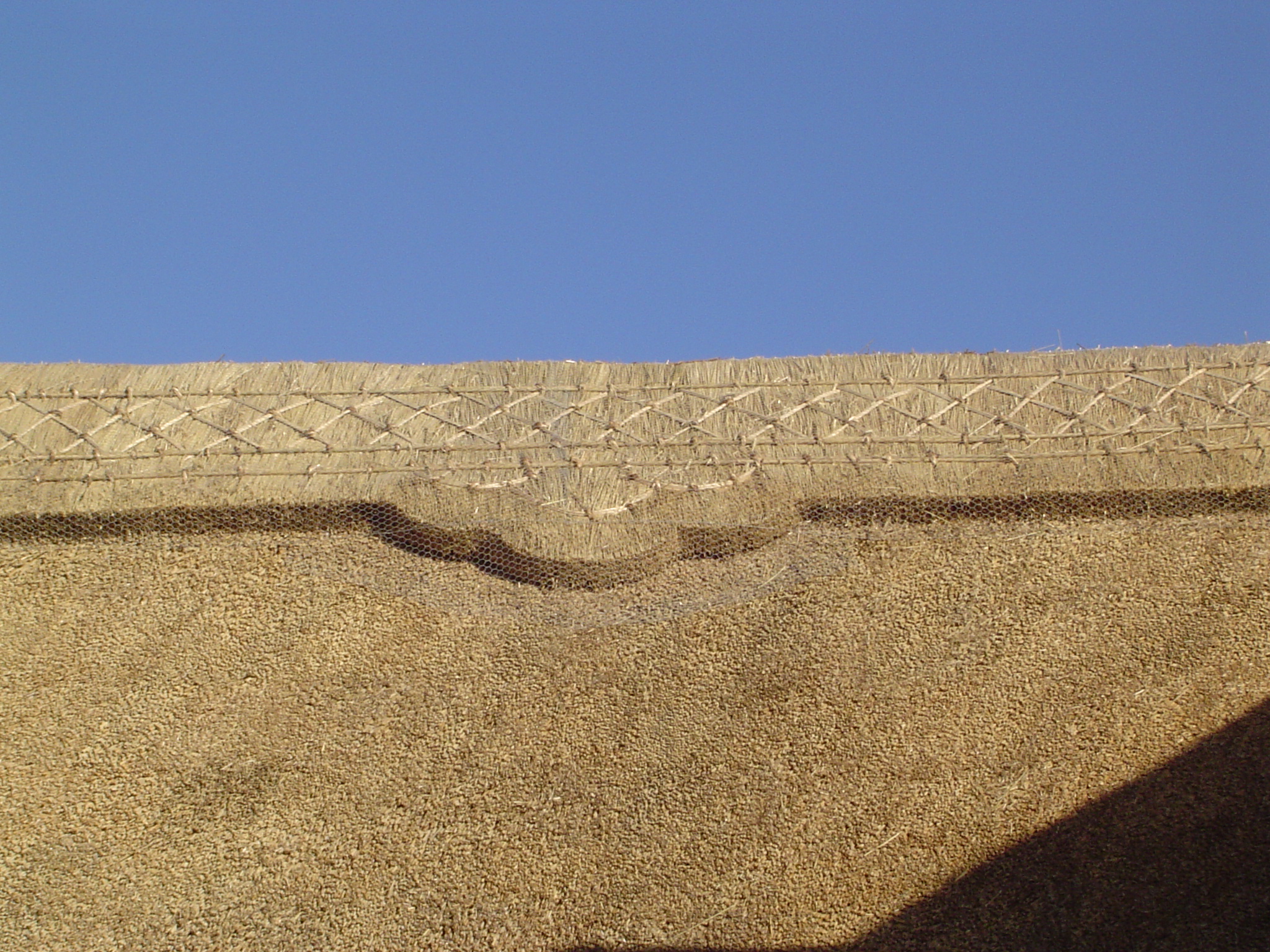
The ridge is the most exposed line on the roof. Water reed is a poor bending material, so the capping is commonly wheat straw, sometimes rye or another flexible stem, or a traditional sedge treatment where that is the local pattern. Two broad forms are used:
– Flush ridge: follows the roof line and does not stand proud.
– Block ridge: built up and cut to a raised block along the apex.
The ridge is stitched or pinned, often with liggers and cross-rods, into a pattern that also locks the material down. Decorative spar work is secondary to water-shedding and wind resistance. A failed ridge lets water into the apex long before the main coat is worn out.
Barges and eaves need a clean drip. Verges may be cut or wrapped so wind cannot get under the edge. Around chimneys, flues must remain safe: correct clearance, flashing or thatch-safe detailing, and no reed packed against a hot flue. Valleys and dormers should be swept so water leaves the roof rather than sitting in a dish. Netting is sometimes fitted against birds; it must not trap wet debris against the face.
QUIZ: Ridges, Barges, and Weather Details
Question 1 (Single choice)
A block ridge is:
- A) Raised and cut to stand above the roof line
- B) Always made of concrete
- C) The same as a gutter
- D) Laid only at the eaves
Correct answer: A
Question 2 (Single choice)
Ridge material is often:
- A) Flexible straw rather than stiff water reed
- B) Wet cement only
- C) Loose gravel
- D) Unfixed reed standing upright
Correct answer: A
Question 3 (True/False)
A worn ridge can admit water before the main coat is finished.
Correct answer: True
Question 4 (Single choice)
Chimney work must provide:
- A) Safe clearance and proper weathering around the flue
- B) Reed packed tight against a working flue
- C) No inspection
- D) A flat valley that holds water
Correct answer: A
Question 5 (Single choice)
Barge and eaves details should:
- A) Shed water clear of walls and resist wind lift
- B) Direct water into the wall head
- C) Be left open to the wind
- D) Be covered with soil
Correct answer: A
————————————————
LESSON 10: Lifespan, Maintenance, and Repair
Water reed wears from the outside. Sun, wind, and wetting and drying slowly remove the butt face. A commonly cited wear rate is about 6 mm a year, so a 150 mm cover over the fixings is on the order of a couple of decades of cover. Site and reed quality change that figure. Moss, overhanging trees, and trapped leaves hold moisture and should be managed. Birds and rodents pull stems; netting or prompt repair limits the damage.
Annual checks are enough on a sound roof:
– Look for slipped courses, shiny or dark damp tracks, and exposed fixings.
– Clear gutters and keep the drip off the walls.
– Note the ridge, barges, and chimney junctions.
– Do not walk the surface without proper boards.
Repair is usually by section. Because reed is compact, a small soft patch is less forgiving than on long straw. When the fixings are near the face, or the coat is thin and tired, recoating or stripping is safer than another thin overlay. Ridge renewal every 10–15 years is normal maintenance, not a failure of the main coat.
Keep simple records: reed source, year, coat thickness, fixing type, and ridge date. Future thatchers need that information.
QUIZ: Lifespan, Maintenance, and Repair
Question 1 (Single choice)
A rule-of-thumb wear rate cited for reed is about:
- A) 6 mm per year
- B) 6 metres per year
- C) No wear at all
- D) 60 mm per week
Correct answer: A
Question 2 (Single choice)
Overhanging trees are a problem because they:
- A) Keep the coat wet and drop debris
- B) Always lengthen reed life
- C) Replace the ridge
- D) Fix the sways
Correct answer: A
Question 3 (True/False)
Ridge renewal is a normal part of maintenance.
Correct answer: True
Question 4 (Single choice)
When fixings are close to the face, the better choice is often:
- A) A proper recoat or strip rather than a thin cosmetic layer
- B) Paint
- C) More trees against the roof
- D) Removing the pitch
Correct answer: A
Question 5 (Single choice)
Useful maintenance records include:
- A) Reed source, year, thickness, fixing type, and ridge date
- B) Only the paint colour of the door
- C) Nothing
- D) The weight of the ladder only
Correct answer: A
————————————————
LESSON 11: Safety, Regulations, and Next Steps
Thatching is work at height with heavy bundles, sharp tools, and a combustible finish. Plan access, exclusion zones below, and manual handling before the first bundle goes up. Reed dust and fungal spores from old thatch call for suitable masks when stripping. Old coats can hide wasp nests and sharp wire.
Fire is the owner’s long-term issue as well as the thatcher’s. Chimneys, electrical penetrations, spark arrestors where appropriate, and clearances matter. Some public buildings need additional fire construction to meet regulations. Insurance should be confirmed before work starts.
In Ireland, many thatched buildings are of heritage interest. Altering material, ridge pattern, or structure on a protected building can require consent. The Department of Housing built-heritage thatch repair guidance and local authority conservation staff are the right references, not guesswork. Grants, where available, often require approved methods and thatchers.
Next steps:
– Read Thatch: A Guide to the Repair of Thatched Roofs (Department guidance, 2015) and current local rules.
– Visit sound reed and straw roofs and learn to tell them apart. Professional water-reed examples: https://ThatchingIreland.com.
– Assemble a starter kit from https://ThatchingTools.ie.
– Book a workshop at https://Thatch.Boglands.ie, then seek time with a working thatcher.
– Practise bundling, dressing with a leggett, and setting a short eaves sample on a mock-up before touching a client roof.
This course is an introduction. Competent thatching is learned on the roof, under supervision.
QUIZ: Safety, Regulations, and Next Steps
Question 1 (Single choice)
Before working on a protected thatched building you should:
- A) Check whether consent is required
- B) Change the material without asking
- C) Strip the roof overnight
- D) Ignore fire and access
Correct answer: A
Question 2 (True/False)
Thatch is combustible, so chimney and fire details matter.
Correct answer: True
Question 3 (Single choice)
A sensible learning path is:
- A) Read guidance, take instruction, and practise on a mock-up before a client roof
- B) Start on a three-storey protected house alone
- C) Skip all fixing practice
- D) Use wet reed to save time
Correct answer: A
Question 4 (Single choice)
When stripping old thatch, a sensible precaution is:
- A) Respiratory protection and care for hidden wire or nests
- B) No mask and no gloves
- C) Burning the coat in place
- D) Standing on unsupported reed
Correct answer: A
Question 5 (Single choice)
This course by itself:
- A) Qualifies you as a master thatcher
- B) Does not replace apprenticeship, design checks, or legal consent
- C) Removes the need for insurance
- D) Sets the building regulations
Correct answer: B
================================================
INSTRUCTOR NOTES
================================================
– Create each LESSON block as a Text lesson.
– Create each QUIZ as a separate Quiz placed directly after its lesson.
– Single Choice for A–D questions. True/False for true/false questions.
– Suggested passing grade: 70–80%. Show correct answers after submission if learners should review.
– Add your own photographs of bundles, leggett work, scollops, steel sways, flush and block ridges, and the eaves kick.
– Keep these links in the course:
https://ThatchingIreland.com
https://ThatchingTools.ie
https://Thatch.Boglands.ie
This content is educational. Lifespan, fixing, and legal requirements vary by site, specification, and current regulations.
Ask Grok (AI agent)